Why collapse is inevitable
Part 2: The age of emergent disasters

Part 1 argued that modern humans are maladapted by nature and nurture to the world they themselves have created. Our paleolithic brains are befuddled by the sheer scale, complexity and pace of change of our socio-biophysical environments. Our contemporary (yet ‘natural’) simplistic, reductionist mechanistic ways of approaching this new ‘reality’ fail to enlighten.
Part 2 makes the case that much of our befuddlement is due to the onslaught of unfamiliar, dangerous, scale-induced emergent phenomena including cultural pathology. We cannot control the chaotic world that is unfolding from the clash and convergence of large complex systems, both cultural and biophysical. The evidence suggests that modern techno-industrial (MTI) societies have been irreversibly expelled from the sustainability Garden of Eden and are in danger of being ‘selected out’ altogether.
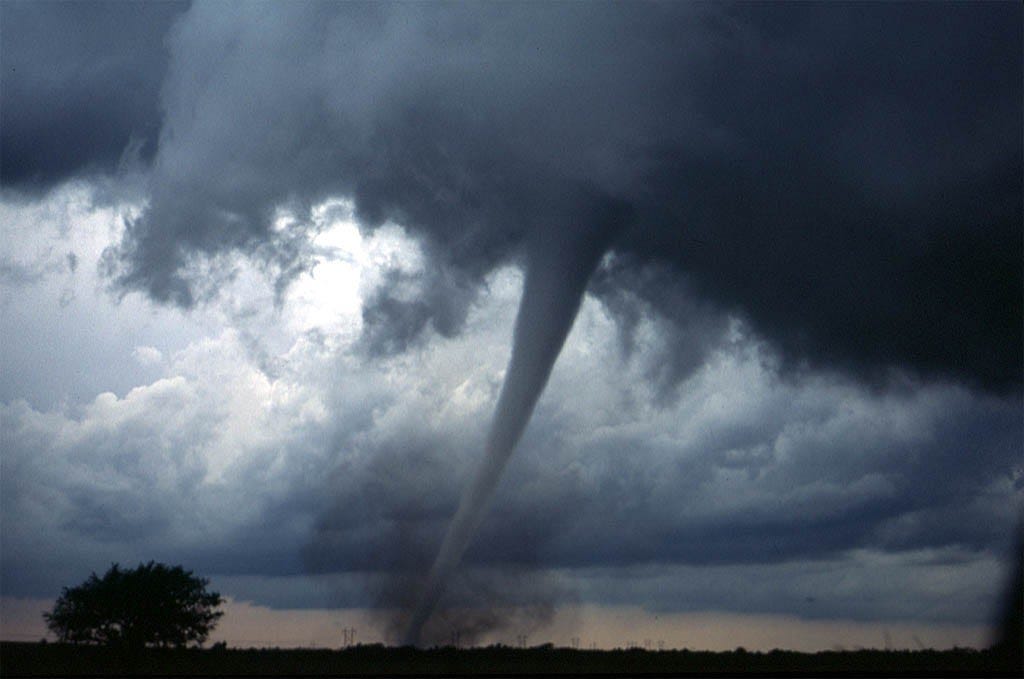
Tornado – natural emergence at its violent best
Photo: NOAA
Emergent phenomena
‘Emergence’ describes complex systems properties or behaviours that result from of the interaction of two or more systems components (or whole systems) but that are not properties of, or detectable from, the structure or behaviour of the individual components. We can anticipate that, in an era of rapid change, explosive economic growth and countless unprecedented systems interactions, particularly between the human enterprise and the ecosphere, there will be many emergent phenomena with regrettable consequences. However, the nature and scale of these phenomena may not be evident until they, well… ‘emerge’.
Examples of emergence proliferate at every spatial scale. Many involve the interplay of technology with biophysical nature. Consider the innumerable possibilities for unpredictable consequences generated by the over 350,000 synthetic chemicals that have been let loose in the ‘environment’ as they encounter each other, natural biochemicals and living organisms. The majority of industrial chemicals have not been adequately tested, yet thousands have been detected in our food supplies and every organ of the human body. (Humans gotta be crazy!) Environmental contamination is implicated in the 50%-and-climbing decline in male sperm counts in the past half-century; one recent study found that modern human brains contain about 7 gm of microplastic particles (the equivalent of a plastic spoon), that the quantity is rapidly increasing[1] and that higher levels of contamination are associated with dementia. Neither trend was anticipated before the fact.
Some cases of emergence can afflict single individuals: your father’s dementia may emerge as those microplastics interfere in some as-yet-unknown way with his brain activity; alcohol or drug addiction emerges with substance-induced gradual changes in brain structure and function; hallucinations emerge from the interaction of psycho-active chemicals and the synaptic networks of the brain.
Other examples affect large biophysical systems or the entire ecosphere. A purely natural phenomenon (though humans may be increasing their frequency and violence) is tornadoes, energy dissipating structures that can emerge from major thunderstorms when dry, usually cold, frontal systems collide with moist unstable air masses. Human-caused emergence includes: the thin eggshell syndrome that extirpated many populations of raptors in the mid/late 1900s (including the bald eagle in the lower 48 US states). Thin-shell syndrome emerges from the hormone mimicking/endocrine disruption action of chlorinated hydrocarbon biocides, particularly DDT and its break-down product, DDE, on previously unknown steps in the birds’ eggshell production system; atmospheric ozone depletion emerged when fugitive modern refrigerants (e.g., chlorofluorocarbons or CFCs) destabilized stratospheric chemistry; the spread of ocean anoxic (or ‘dead’) zones emerges from the die-off and subsequent oxygen-depleting decomposition of massive algal blooms, which themselves result from domestic sewage and agricultural (fertilizer) runoff, likely exacerbated by yet another human impact, anthropogenic global heating. And, of course, global heating itself is an emergent property of green house gas accumulations in the atmosphere (particularly carbon dioxide from burning fossil fuels) upsetting global heat balance. In fact, virtually all co-symptoms of overshoot are emergent phenomena that spring from the clash between growth-addicted industrialization, whatever its political form, and the steady-state dynamics of the ecosphere. (Reminder: Overshoot is ultimately a terminal condition. There are too many people consuming and polluting too much.)
Political and socio-economic systems are also rife with internal emergent properties. No surprise there—‘civilization’ itself is arguably a macro-emergent phenomenon tracible to the adoption of agriculture just eight or ten millennia ago. For the first time, ample food surpluses led to the co-emergence of permanent settlements, populations orders of magnitudes greater than Dunbar’s number,[2] social hierarchies (class structure), and division of labour (including the priesthood, politicians, a merchant class, and bureaucrats and peasants). And we can’t forget the appearance of armies, deadly conflicts, territorial conquest, universal slavery, and myriad other unwelcome negative phenomena such as zoonotic diseases (transmitted from animals) pandemics and soil/landscape destruction as ‘civilization’ impinged upon non-human nature.
Think about this: It can be said that, since the adoption of agriculture 10,000 years ago (a mere ~3% of H. sapiens history): a) no so-called ‘civilized’ town-dwelling human being has lived under evolutionarily or ecologically ‘normal’ circumstances: b) aberrant outcomes are therefore to be expected—and, indeed, most so-called civilizations (‘abnormal’ all) have ended in ignominious collapse. Human beings have simply not evolved the psycho-cognitive capacity to live sustainably or for long in complex large-scale societies.
Meanwhile, non-growing small-scale ‘societies’ can—and still do—manage well enough without self- or eco-destruction.
Societal collapse as programmed emergence
Various authors have theorized on the surface mechanisms and sequential changes that characterize the emergence and evolution-to-collapse of human societies. For example, Joseph Tainter’s well-known characterization starts from the proposition that human societies are problem-solving entities. They start small, with no or very simple institutional and governance structures but, as they expand, they invariably encounter problems that impede further ‘development’ or threaten survival unless they adapt. Which they usually do—but adaptation requires complexifying which, in turn, induces serial emergent phenomena.
Consider the following sequence: as tools improved (stone to metal weapons, for example), many hunter-gathering tribes over-harvested or over-hunted their home ranges. To overcome the problem of food shortages, some were able to adopt agriculture. But the resultant food surpluses enabled unprecedented population growth and sedentary communities which demanded greater socio-political complexification as previously described. Eventually, even with primitive farming methods, the emerging settled society would deplete or otherwise degrade local soils. This problem might be ‘solved’, initially, by clearing adjacent forest but eventually growth pressures would require aggressive territorial expansion. Of course, population and territorial expansion would necessitate further societal complexification—additional levels of government, a larger bureaucracy, higher taxes, more human slaves, a large standing army, etc.
At first (and this may mean over the course of a century or three) the emerging culture might be vibrant, robust and highly resilient, but with each major problem ‘solved’ and subsequent boost in complexity, it suffers diminishing returns (increasingly less benefit per unit effort). At the same time, government and bureaucracies become increasingly top-heavy; privileged elites capture a disproportionate share of wealth; disputes and corruption set in; the economy falters and inflation debases the currency. As traditional structures fail, ordinary citizens feel abandoned. With ‘the people’ feeling disenchanted and less supportive of their leaders, society fractures, hostility increases among interest groups and civil disorder becomes increasingly common (sound familiar?).
In short, with increasing scale, resilience erodes. Society becomes brittle and vulnerable—even unresponsive—to the next major shock (e.g., climate change, resource shortages, insurrection or invasion). This is a cultural tipping point; the future will be little like the past. The inability to respond effectively—i.e., to complexify further—triggers the opposite, a series of events leading to significant societal simplification (including loss of population) or collapse. Collapse can be fast or slow and more or less painful and violent.
The genetic connection
The fact that something similar to this Tainterian sequence describes dozens of complexifying human societies/cultures since the dawn of ’civilization’ strongly suggests that there is something—or several things—fixed or pre-determined, about the socio-political behaviour of humans in large groups. Cultural myths, norms and narratives may vary widely, but different peoples, worlds apart, behave in roughly predictable ways in similar circumstances; with increasing scale and complexity, deceit, dishonesty, self-aggrandisement and dominance-struggles frequently emerge at the top. With government corruption, institutional incompetence and popular unrest, organized states are prone to corrosion and collapse. The evidence suggests that societies of H. sapiens self-organize and grow, partially under the influence of innate behavioural predispositions, which, in most circumstances, guide socio-cultural development so that it generally follows the sequence of ‘growth-with-complexification-to-unravelling’. The relevant innate features of human psychology and social behaviour involved in the sequence have not changed in the brief history of civilization.
We should keep three things in mind in considering this hypothesis:
1) To claim a significant bio-evolutionary influence over societal life-histories is not full-on genetic determinism. Anthropologists and other humanists would argue that societal evolution is contingent on culture-specific socio-political and local ecological factors. Fair enough—this no doubt accounts for the myriad differences among societies. However, it cannot explain the broadly similar pattern of ‘rise-only-to-fall’ observed in dozens of discrete complex societies, in different environments, over many millennia;
2) The repeated cyclical collapse of large-scale human societies does not mean there is something fundamentally ‘wrong’ with most individual human beings. People behave naturally (do they have any choice?) as best they can in their particular type of unnatural cultural circumstances throughout the cycle. The problem is catalysed by excessive scale;
3) The entire sequence of complexification-to-unravelling reflects a journey from manageable simplicity to the incomprehensible chaos of scaled-up compound emergence.[3] We seem, invariably, to reach a stage in the journey at which human societies can no longer maintain either socio-cultural integrity or ecological stability.
Bottom line
The collapse of complex societies results from a mismatch between the innate cognitive capacities of the growth-oriented human genome (in whatever culture-specific guise of perceiving the world) and the systemic surprises that emerge from excessive scale. Our essentially Paleolithic brains and associated social behaviors are functionally obsolete to manage the myriad emergent phenomena invariably associated with the internal machinations of large societal organizations or their interactions with the biophysical systems that contain them. The situation today is infinitely complicated for a global culture consisting of multiple disparate, competing, mutually hostile, resource-needy societies simultaneously confronted with the biophysical limits imposed by a finite planet.
Let me be clear—this is a true predicament, not a solvable problem. I am arguing that H. sapiens does not evolve socially stable, eco-compatible large-scale complex societies because we cannot evolve socially stable, eco-compatible large-scale complex societies. Such societies simply do not ‘emerge’ from the neuro-cognitive algorithms that help determine unnaturally large-group human behavioural-dynamics, particularly the dynamics of generated by global MTI society.
In Part 3, we will explore one neurocognitive mechanism that seems to be implicated in positively fomenting societal evolution-to-collapse.
[1] In pace with plastic production which has been doubling every 15 years or less.
[3] Simultaneous endogenous (within-society) and exogenous (between humans and the biophysical environment) interactions.
I find your framing of collapse as an emergent consequence of scale and complexity deeply persuasive, and it aligns closely with my own thinking about digital technology as a parallel emergent phenomenon. At sufficient scale, the technosphere no longer functions merely as a set of tools but as a behavior-shaping environment that further overwhelms our Paleolithic cognitive capacities and distances us from biophysical reality. In that sense, digital systems may be understood not as a separate crisis, but as one of the cultural pathways through which overshoot and fragility now express themselves.
Yup. This is how I've framed my thinking for a few years now, and it has really clarified a lot of previously confusing points for me. I appreciate you articulating so well, doc.