The population conundrum
What goes up will come down (and harder than you think)

The thing about population
One of the most curious features of the mainstream unsustainability debate is almost complete absence of reckoning with ‘population-as-obvious-driver’. The subject remains taboo, mustn’t go there. Even serious degrowthers avoid discussing actively degrowing the human population.
This is, as they say, regrettable.
Unsustainability is about overshoot and overshoot is about humans consuming beyond nature’s recovery rate and dumping wastes in excess of nature’s assimilation capacity. In short, there are already too many people consuming and polluting too much. Need I note (again) that overshoot is, by definition, ultimately a terminal condition?
These are not casual observations that we can merely take under advisement, things that we might consider later if it doesn’t cost too much. In particular, if it is obvious the total human impact on Earth is the product of average impact per person and the number of people doing the impacting, why is population reduction not a major focus of sustainability survival planning?
“Unfair,” you protest, “not all humans are equal impactors.”
Quite true, so let’s get the inequality factor (and any taint of racism) out of the way. Data show that that the richest 10% of people are responsible for half or more of carbon emissions; the wealthy quarter of people account for 52% of resource consumption while the poorest quarter get by on only 6%. This means that, should the global community decide to act aggressively to reduce consumption/emissions by the necessary 44% overall, simple justice would demand that the wealthy take by far the greatest hit (~80% reduction per capita in North America).
Fair enough—though rather more easily said than done. The currently well-to-do are, er… inclined to resist. Income redistribution is, like population planning, taboo. Protected by wealth and associated political leverage, major vested interests, particularly the corporate oligarchs who run the world, won’t even discuss the inequality problem—except to insist we can grow our way to sufficiency-for-all.
And there’s another fly in the equality ointment—even a successful ‘great leveling’ would by no means relieve us of the population question:
· First, overshoot means that even if all 8.2 billion humans had identical lifestyles and ecological footprints, we’d still be in overshoot. Averaging impacts doesn’t reduce totals; material quality per se is not enough—we’d still have to reduce consumption by almost half.
· Second, in recent decades incremental increases in humanity’s (consumption based) ecological footprint and carbon emissions have been driven more by population growth than by increased incomes/consumption in almost all income categories; population growth is a major co-driver of overshoot.
· Third, billions of people in lower income countries (particularly in Africa) are justifiably striving to attain developed nations’ material living standards. But Earth, in overshoot, is not now sustainably supporting even present average levels of consumption; how could it be expected to cope were all 8.2 billion members of the human family living high on the hog? (Remember, we’re supposed to be reducing aggregate consumption; see first bullet point.)
· Fourth, we’re actually headed for 10+ billion by the 2080s. Most of the projected population growth will occur in those poorer countries with the greatest material needs and expectations. This amounts to adrenaline for overshoot. What are the additional consequences for global heating and ecological stability? ‘Tipping points’, anyone? Still want to ignore population?
To raise overpopulation-as-issue and ask such obvious questions is not racist; it is simply acknowledging crucial realities and the associated moral dilemma.
Avoiding the obvious
Analysts and the world community actually have myriad reasons for skirting the population question—ancient religious prohibitions, fear of being labeled eco-fascist/racist, self-interested resistance to reform, fanatical allegiance to the perpetual growth ethic and growing science denial being among the most prominent.[1] In one way or another, however, most such excuses arguably spring from the deep ‘exceptionalist’ soil of modern techno-industrial (MTI) culture. To wit: Why be concerned about population? Humans aren’t animals, certainly not like the others; we stand above nature and don’t have to be concerned about natural laws. In any case human ingenuity (technology) will sever any population-to-resources link and solve the overshoot problem.
That’s the happy-clappy story we tell ourselves.
Too bad it’s merely a shared delusion. What goes on in our collective brain often has no grounding in reality.
The obvious flaw here is that H. sapiens not only is an animal, but is the major macro-consumer species in every accessible ecosystem on the planet (always at the expense of both our prey species and our competitors for available biomass). If the scale of material use and population were prime criteria, humans are the most successful large vertebrate ever to walk the Earth. The sheer weight of humans is ten times greater than that of all wild mammals combined. More broadly, the human enterprise has effectively merged (albeit destructively) with the ecosphere and is warping major geophysical processes from the climate and water cycles to landscape erosion. Quite the contrary record for a self-aggrandizing rapacious ape that claims to be detached from the natural world.
Just like the others
Which suggests it might be instructive to pay more attention to what we know about non-human population dynamics—there are plenty of examples of overshoot at work in other large mammal species.
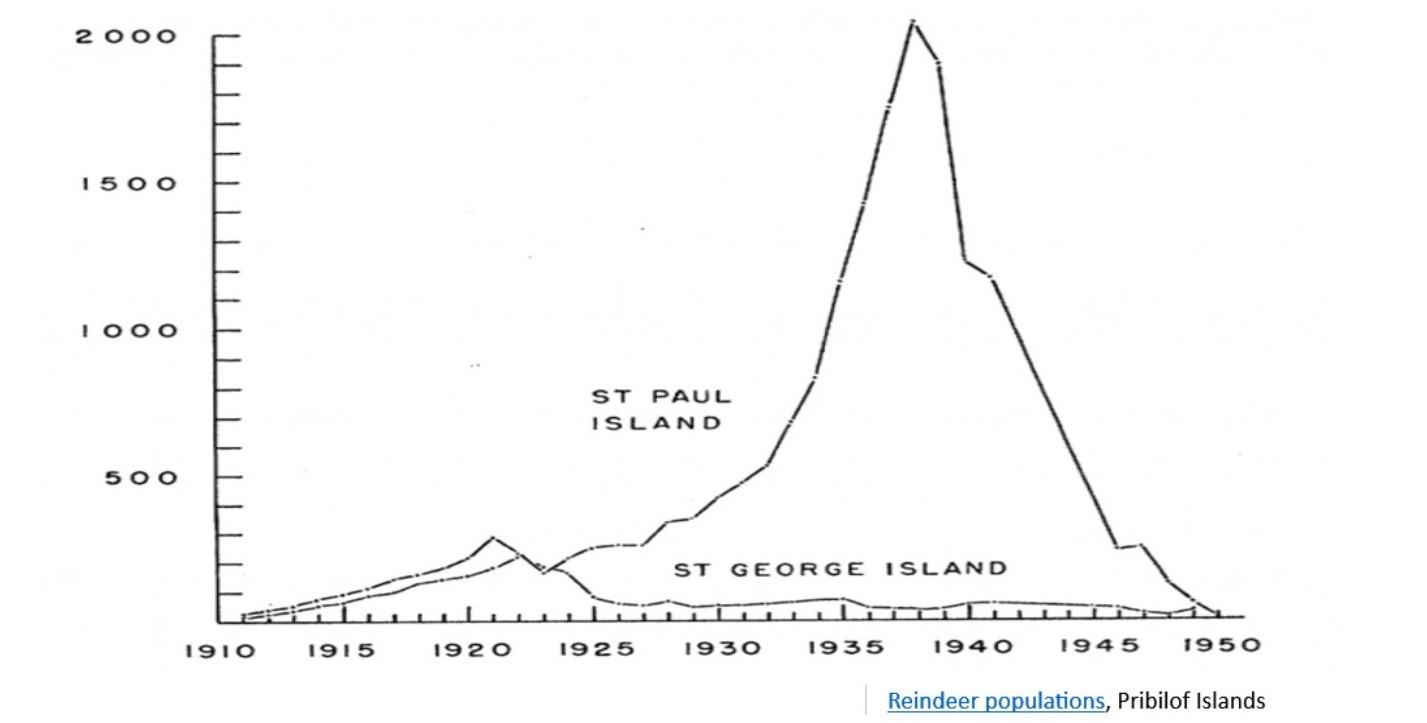
For example, the graph at the top shows the trajectories of reindeer populations in the decades after a few individuals were introduced to the Pribilof Islands off Alaska early in the 20th Century. The islands were resource-rich and predator free. The reindeer, like all species’ populations enjoying favourable conditions, began expanding exponentially. From a handful of individuals in 1911, the St Paul Island herd ballooned to over 2000 individuals in under 30 years before going nearly extinct in little more than a decade. (The St George story was similar but less dramatic.)
The St Paul reindeer’s three decades of expansion provide a classic example of exponential (aka ‘geometric’) growth. This is a form of positive feedback in which each new generation adds to the breeding population ensuring that the next generation will be even larger than itself. The increasing steepness of the curve shows how such ‘compound interest’ accelerates population growth.
An exponentially expanding population has a constant doubling time. After a characteristically slow start in a new habitat, the St Paul herd reached 500 animals around 1931-32, had doubled in less than four years by 1934-35 and doubled again in the next four years, reaching its peak of 2048 animals in 1938-39. The population then crashed spectacularly—there were only eight survivors by 1950. The reindeer had overshot the regenerative capacity of certain lichens, a vital food source in winter. Depleted lichen = starving reindeer, particularly if the winter is exceptionally cold. Out-and-out starvation is one form of negative feedback due to overpopulation; the demise of animals weakened by hunger and succumbing to disease or foul weather is another.
On the upside, the collapse of an over-grazing animal population allows the habitat, particularly crucial food sources, to recover.
So, what have a bunch of starving deer on an Arctic island got to do with we humans?
Quite a lot, actually. For starters, as Malthus emphasized in 1798, humans are just as capable of geometric/exponential growth under favourable conditions as any other species. Malthus also reasoned that we are as potentially susceptible to starvation and other negative feedbacks when circumstances turn South (e.g., when crops fail or pandemics rage).
In this light consider Figure 1. This graph provides a low-resolution portrait of human population over the past 10,000 years, roughly since the beginning of agriculture.
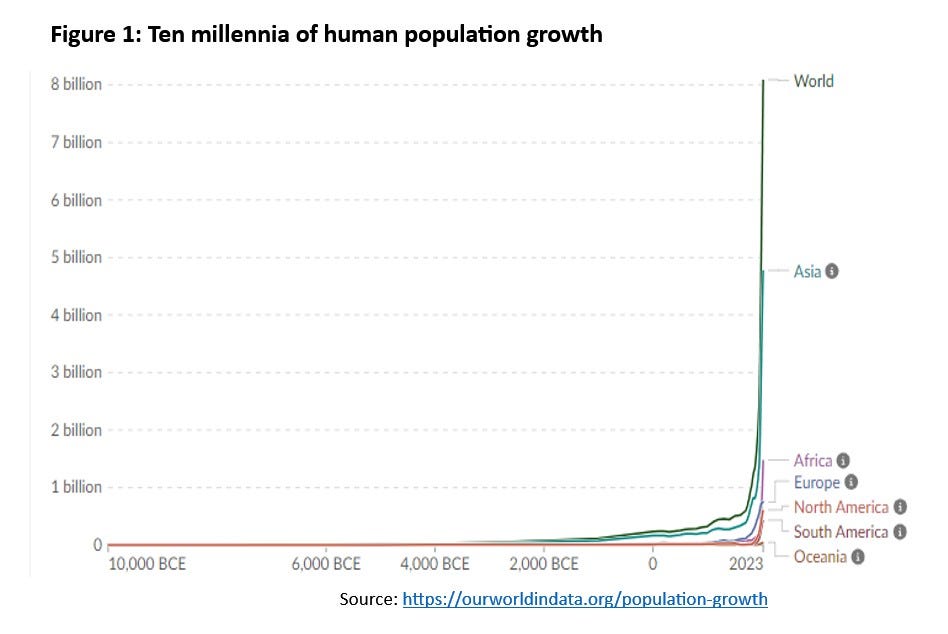
Note that, despite the boost from occasional food surpluses, the population increase for 80% of this period was negligible, averaging only ~.04% annually. Starting from ~4-5 million, it took 8000 years for human numbers to reach just 232 million two millennia ago. The reason is fairly straight-forward; H. sapiens innate capacity for rapid geometric growth (positive feedback) was mostly held in check by local food shortages, constant territorial conflict, and disease (negative feedbacks).[2] As late as the 14th Century, bubonic plague killed off more than a quarter of the European population.
Nevertheless, the population kept growing at a slowly increasing rate. The real boost came with the Enlightenment (beginning in the late 17th Century) and subsequent scientific/industrial revolution. Humanity reached its first billion around 1820 then really took off, eventually on all continents, with improvements in public health and medicine (which reduced death rates) but especially with the exponential increase in fossil fuel-based technologies (which increased food production and access to all other resources needed to support the growing population). Together, these cultural factors enabled humanity to realize its maximum biological capacity for exponential population growth for the first time in human evolutionary history.
Note that the human population trajectory over the past 100 years is a geometric replica of the 30-year explosion of the St Paul reindeer herd (differing only in population size and because the human animal has a longer generation time). By 1927 the human population had reached two billion; we doubled to four billion in ~47 years by 1974-5; the next doubling to eight billion in 2022 also took 47 years (note the constant doubling time).[3] In short, the upslope of the human population growth curve has the same shape as that of the St Paul reindeer herd to peak.[4] It’s nature’s way.
It’s also ‘nature way’ for negative feedback to cut in and strengthen as a population approaches carrying capacity (which depends on habitat productivity and related factors). Figure 2 compares unconstrained exponential growth (2a) with so-called ‘logistic growth’ (2b), the idealized damping of positive feedback by the gradual onset of negative feedback. As population density increases in a specific habitat, so too does competition for food and space; with more crowding, communicable diseases and parasites spread more easily thus increasing mortality; a dense population of prey species attracts predators, increasing the death rate (and producing higher populations of well-fed predators). In theory then, the growth of a population of interest should slow asymptotically as it nears carrying capacity [Figure 2 (b)]. In practice, populations of typical slowly-reproducing mammals like humans tend to fluctuate in the vicinity of long-term carrying capacity as habitat and complex ecological relationships change.
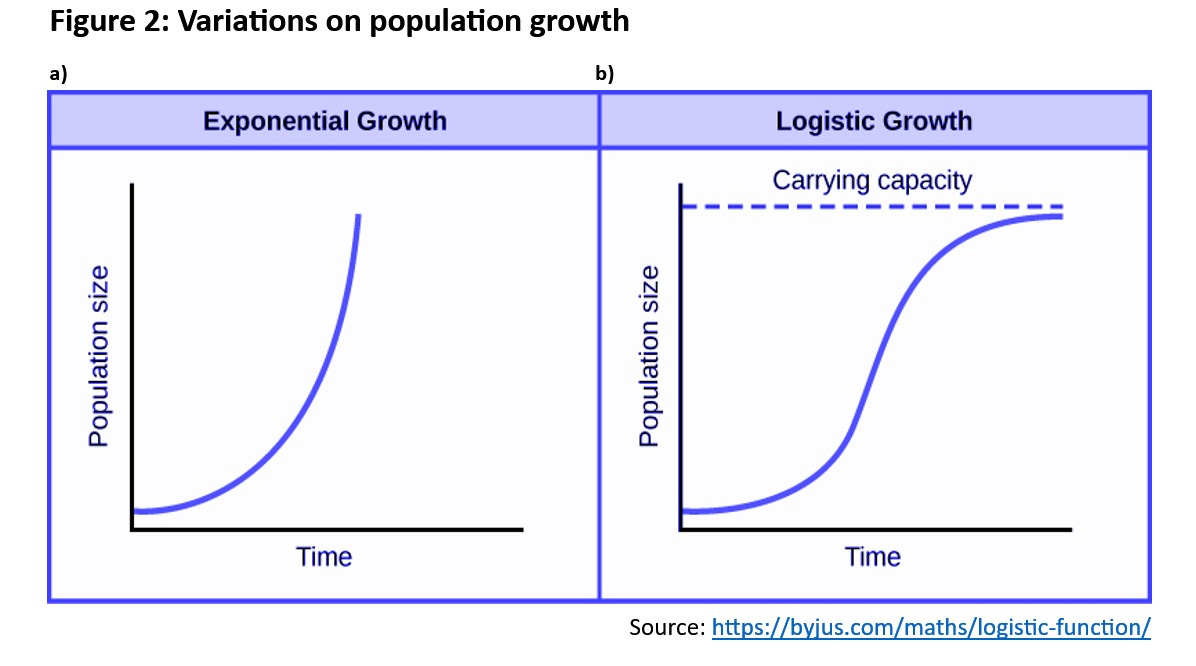
But not always, in extreme cases, particularly in simpler systems such as reindeer on predator-free St Paul Island, the fluctuation may be a dramatic, even terminal, population crash.
Which brings us back to thinking about humans and how far to take our reindeer analogy. The St Paul reindeer population plunged rapidly after reaching peak, but does that say anything important about the human future?
It’s complicated.
Indeed, the human socio-political-ecosystem is vastly more complex and potentially more resilient than was the St Paul Island ecosystem. For example, mainly due to social negative feedbacks,[5] human fertility is actually falling (to the consternation of economists and most governments). The world population is currently expanding at ‘only’ ~70 million people annually, a rate of .85%/year, down and still-declining from the 1963 maximum of 2.2%.
In some ways this is encouraging—one might argue that humanity is gradually approaching peak population and will level off at or below carrying capacity as in Figure 2(b). Conventional wisdom (e.g., United Nations population projections) has it that our population will peak at 10.3 billion in the mid-2080s and then begin a controlled decline to 10.2 billion by 2100. It could be that all is well—crash avoided, airbags unnecessary.
But that’s not the whole story. UN and other conventional population projects are rooted in exceptionalist thinking. They are based entirely on ‘endogenous’ data, e.g., age- and sex-specific mortality rates and average female fertility all abstracted from biophysical reality. There is no consideration of ‘exogenous’ or external factors, the possibility of significant negative feedbacks from the ‘environment’, broadly defined.
Which brings us to Figure 3 (borrowed from my most recent previous post) which includes a should-be-alarming alternative scenario. Note that this graph incorporates Figure 2 (a) and (b). It acknowledges that human carrying capacity is a practical concept, that at any defined average material standard of living there will be a maximum sustainable human population.[6]
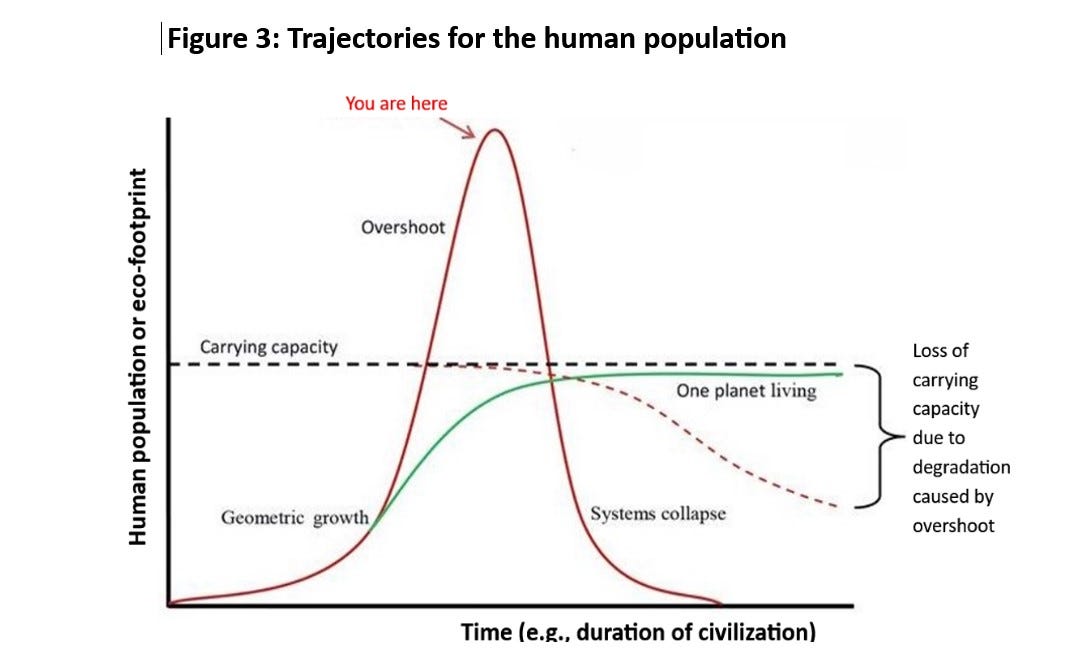
Figure 3 presents the recent human population trajectory as an exponential/geometric growth curve which has, indeed, begun to slow and approach peak (first half of solid red line). However, it also indicates that this peak far exceeds pre-industrial sustainable carrying capacity (dotted horizontal black line). Technology has taken humanity far into overshoot which means that our large and growing population is living and expanding by depleting even self-replenishing resources, from fish stocks and forests, to arable soils and groundwater reserves, and by polluting air, soil and waters beyond natural assimilation rates. In doing so, we are causing global heating, destabilizing climate patterns, extinguishing hundreds of other species and otherwise reducing Earth’s productivity and livability. (As I write this much of the Northern Hemisphere including Western Europe is suffering record heat waves. A third of humanity—more than three billion people—may be forced outside of our species’ historic ‘climate niche’ by century’s end). Global heating brings an increasing risk of wide-spread disease and pandemics—recent measles, hantavirus and ebola outbreaks underscore this point—as well as local energy, food and water shortages.
In short, the evidence suggests that exogenous negative feedbacks are rapidly returning as an additional significant factor in human population dynamics. Trump’s war and the closure of the Strait of Hormuz (which has broken crucial global supply chains for petroleum, natural gas, urea fertilizer) is providing a preview of a possible global future of chaos and suffering that will eventually visit millions/billions of people as resources run down and limits are breached.
What might have been
Note that an actively intelligent species, one that accepted its niche in the natural world and understood population and systems dynamics[7], would have self-managed to ensure that its population followed the sigmoid growth curve gradually slowing growth to equilibrate (fluctuate, actually) in the vicinity of long-term carrying capacity (Figure 3, solid green line). Maintaining a civilization at a reasonable material standard yet within the productive capacity of its supportive ecosystems is called “one-planet living”.
As matters stand, MTI civilization is a victim of culture-wide self-deception. We have blown the opportunity to optimize or ‘green line’ human life on this single planet Earth. Other eco-oriented demographic analyses agree that Earth cannot support even the present population without a transformation of mainstream MTI cultural beliefs, values, assumptions and behaviours. Resource depletion, ecosystems destruction and destabilization of global life-support functions have reduced long-term bio-productivity and, with it, human carrying capacity[8] whatever the preferred material standard—and this corrosive process is obviously continuing.
The likely outcome is a ‘great simplification’ of MTI societies, much as was projected by the business-as-usual scenario of the original 1972 Limits to Growth report and several follow-up studies of real-world post 1972 trends. Are we prepared for major economic contraction and accompanying population ‘correction’?
We have too long downplayed the population question. The best humanity can now achieve as we come off peak, is to track the dotted red line (Figure 3) and work toward stabilizing our population within the much-reduced productive means of nature. It is long past time for the global community to dissolve the population taboo and adopt an antinatalism-inspired procreative ethics. Should we succeed, future generations will live at numbers well below pre-industrial carrying capacity (dotted black line). This assumes we don’t render ourselves extinct in the resource and habitat conflicts that will accompany the coming implosion (total systems collapse segment of the solid red line).
Epilogue
There are no secrets about any of the above. The threats posed by advanced overshoot fills academic journals and even recent policy analyses; ecologists have studied many boom-bust cycles in nature; the unique elements of human population dynamics are well known; policy makers are well-versed in all sides of the (un)sustainability story. Yet quirky MTI culture still denies the population problem.
All of which goes to show, once more, that macro-scale (corporate, national, geopolitical behaviour) is rarely guided by mere facts and analysis unless the latter support existing mythology, economic narratives, development policies and, of course, our governing elites. The modern ‘system’—MTI culture—has acquired a momentum of its own, powered by innate behavioural tendencies; religious doctrines; equally fantastical cultural narratives (e.g., human exeptionalism and infinite economic growth); powerful influencers; privileged self-interest; emotional resistance; willful blindness and a large dollop of popular indifference/ignorance.
The coming implosion should therefore hardly come as a shock. It is the inevitable product of a defective cultural algorithm combined with human cognitive malleability. The most recent ten generations of modern humans (out of ~17,000 generations) have lived mostly unaware that these are truly exceptional times. MTI peoples have been mesmerized into thinking that continuous economic and population growth are normal and ‘to be continued’; in counter-fact, the past 200 years of fossil-powered growth is the most anomalous period in human history and is ‘to be curtailed.’
The human population went way up; it will come down.
Perhaps some will find comfort in knowing that, one way or another, the next century will see a return to normalcy. Conceivably, like St Paul Island, our Earthly habitat will eventually recover from humanity’s over-grazing.
The seeming inevitability of the transition does not, however, relieve the present generation of responsibility. This is no time to relax; we theoretically still have a choice between acting in ‘normal’ ways that facilitate a fast and brutal collapse or of exercising our much-vaunted high intelligence by coming together cooperatively to manage a controlled and humanely equitable soft landing.
Where would you put your money?
[1] Actually, and perversely, we’re not exactly ‘skirting the population question’. Many high-income countries are actively promoting pro-natalist policies to maintain or grow their populations in the face of declining fertility. Instead, these countries should be celebrating peak population and adapting to contraction.
[2] Positive feedback occurs when a change in a systems variable generates further change in the same direction (deviation reinforcing). Negative feedback occurs when a change in a systems variable results in suppression of change in the same direction (deviation counter-acting).
[3] The instantaneous population growth rates actually increased initially during these periods rising, in humanity’s case, to a maximum of 2.2%/annum in the early-mid 1960s.
[4] The compressed time scale and steepness of the curve obscures this fact.
[5] E.g., greater economic freedom for women, improved family-planning education, increasing availability of pregnancy prevention technologies, concern about bringing children into an unstable world, etc.
[6] The numerical maximum can vary substantially. All else held constant, Earth could support more people at a modest material standard than if we all choose to live high on the hog (apparently the MTI default position).
[7] H. sapiens did actually understand all this but, being above nature, chose to ignore mere biology.
[8] Bio-productivity or biocapacity is a quality of ecosystems and should not be confused with carrying capacity which is always a population number. The two variables are related, of course—a highly bio-productive habitat (e.g., temperate grasslands) will support more people at any defined material standard than will a comparably-sized low-quality habitat (semi-arid scrubland). (See also Note #6.)
“Two realisations can act as beacons to light our way through this fog of mystification.
The first is that meaningful growth has ended, and that the economy is starting to shrink.
The second is that nobody, in any position of authority or influence, can possibly afford to admit that this is happening.” Economist Dr Tim Morgan
https://surplusenergyeconomics.wordpress.com/2026/01/30/318-the-surplus-energy-economy-part-one/
The central problem now is human psychology. We smile condescendingly at cults such as the Jehovahs Witnesses or the Moonies, yet we live within a cult: the dominant global religious delusion of endless GDP growth. It is now a form of self-harm; yet questioning it is seen by the corporate mind as outrageous blasphemy.
It's hard to convince people to ditch cult beliefs, but we have to try. If nothing else, we have duty to document our collapse. This is the fight of our lives.
https://newptc75.medium.com/human-nature-and-the-climate-041b9273653e
I have been looking at the mechanisms for population decline, and running some models (based on World3) and one notable feature is that the momentum of population is hard to turn around. A reduction in life expectancy, such as a 10 year reduction, actually has little effect for decades as it works through the existing populations.
The main population reduction effect comes from a reduction in births, and that mostly from a decision to not have children. Typically that is due to poverty (although can work either way), existential angst about bringing children into such a world, and anti-child attitudes and policies. In short, no answers that solve our problems of excess humans in time to divert from avcrisis, such as wars and famines.
There are other possibilities though, that you touch upon:
The most effective and fastest is a collapse in Western economies, specifically the American economy and the American Dollar. That could destroy the richest and worst consumers on the planet almost immediately, both American consumers and corporations, and massively reduce oil and gas consumption and production, especially highly polluting fracking and tar sands.
The Dollar collapse would wipe out many billionaires and millionaires around the World, and destroy the value of large agglomerations of wealth, such as national reserves. Many of the most polluting effects of Westernised economics would be greatly diminished, which is after all the real point.
Similarly is the collapse of the fossil fuel industries that feed us, and by turning fossils into food created this problem of 6 billion excess humans. That is, in fact, much closer than most people imagine. The net energy equation of 'net EROEI at the point of useful work' is quickly sliding towards zero, meaning we would actually need more and more gross production just to stand still. That isn't happening, and Hormuz just made it much worse, cutting off the high EROEI fuel from the markets. That alone will cut the food that feeds us, and that will cut the populations.
The ultimate Malthusian collapse is primarily through famine, and I think it is already underway later this year as the combination of Hormuz closure and 20% less diesel and 30% less fertiliser, along with a Super El Niño causing heatwaves, droughts and a weakened monsoon, will kill millions, particularly in the 'Hunger Months' from Xmas to early summer of 2027. And then worse and worse to follow.
The real test for humans will be their response to this entirely man-made crisis; understanding, acceptance and mitigation, or descent into further genocides and border wars. I have my own views on that. I hope I am proven wrong in the future.