Why collapse is inevitable
Part 3) MTI culture as mega-psychopath

Part 1 argued that modern humans are maladapted by nature and nurture to the world they themselves have created. Our paleolithic brains are befuddled by the sheer scale, complexity and pace of change of both our socio-cultural and biophysical environments.
Part 2 suggested that much of our befuddlement is due to unfamiliar behaviours and circumstances that emerge from the internal machinations of large-scale societal organizations and their interactions with the biophysical systems that contain them. Our Paleolithic brains are not up to the challenge. Socially stable, eco-compatible large-scale societies cannot emerge from these turbulent confrontations. Part 3 makes the case that what does emerge is something else altogether—gross societal malfunction-to-collapse—which may be at least partially explained by pan-cultural ‘psychopathy’.
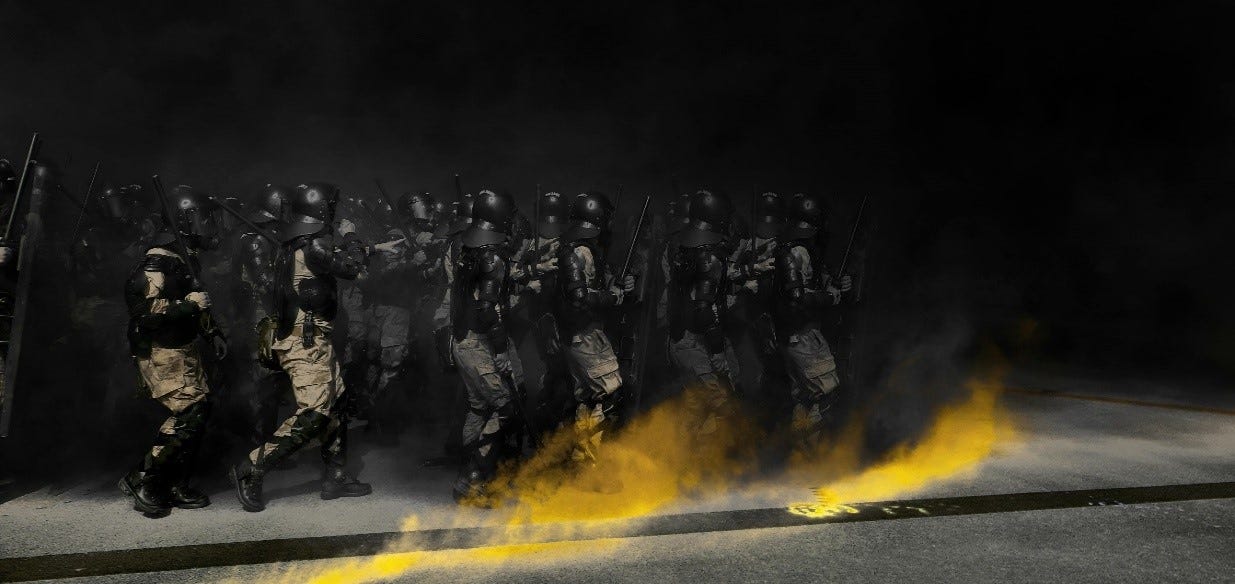
Authoritarian repression – social emergence at its violent (almost) worst
Photo: Emre Ezer
When aberrance becomes the norm
Psychopathy is an uncommon but particularly pernicious personality/behavioural disorder. Psychopathic traits include insincerity, egocentrism, the inability to express empathy or remorse and manipulative behaviours including a tendency toward (possibly violent) dominance assertion. Such anti-social behaviour may be masked by smarmy, superficial charm. Psychopathy is pernicious because, despite relative rarity (~1% of the general population), the trait has left a dark, enduring and still-spreading stain on the tapestry of human affairs.
Studies show that psychopathic personalities are disproportionately represented—by an order of magnitude—among occupants of head offices in finance and business and at high levels in government, i.e., at centers of wealth creation, prestige and power. Psychopaths are often risk-takers which may pay off, but this is also potentially devastating to any organization in which they assume a leadership role. Indeed, “a significant number of high-profile business collapses are arguably linked to a specific psychological profile.”
Significantly, psychopathy is associated with observable differences in brain structure and function and therefore likely has a genetic component, albeit one that may be triggered or abetted by social circumstances. Indeed, the capacity to charm and deceive without remorse can lead to enhanced opportunities for such things as illicit money-making and sexual exploitation. The latter may explain the persistence of the disorder in most human populations through the ages. As suggested by risky and promiscuous lifestyles, most psychopaths are men.
While some people with psychopathic tendencies can function normally most of the time, others are, at bottom, not nice people. Afflicted individuals lack the necessary brain structure and neural connections to ‘present’ as normal human beings. Donald Trump,[1] Vladimir Putin, Benjamin Netanyahu, Adolf Hitler, Josef Stalin, Mao Zedong and their ilk are/were not nice people. They cannot be reasoned with; to them, reality is simply what they say it is; objective truth and contrary evidence are meaningless; their actions show disregard for international law and diplomatic norms not to mention human life (many are murderers). They may be pathological narcissists, but their shallow charm enables them to exploit the friendship of associates and their positions of trust in the organizations over which they may even gain control. In short, individuals with psycho-disorders can even more readily rise to crucial positions of corporate and global leadership than their otherwise peers.
It is worth noting that, in relatively small hunter-gatherer or similar tribal communities, the expression of harmful psychopathic behaviours would be quickly socially suppressed. Some North American ‘First Nations’ framed evil community-destructive compulsions as ‘wetiko’. The afflicted could not hide, everyone knows everyone else, anti-social actions are immediately attributable to the responsible individuals. Negative feedback from the community would help ensure that self-aggrandizing, selfish, deceitful or manipulative behaviour—particularly anything that jeopardized the group—would be severely punished by deprivation, temporary exclusion, banishment or worse.[2] The distressed personality moves out, the community moves on.
In many respects, such a ‘normal’ way of being in, and maintaining, community most closely resembles true egalitarian democracy. Everything changed with the advent of large-scale societies and their internal organizations. Hierarchy prevails and, at the top of major corporations, international organizations, governments and bureaucracies, psychopathic traits can become assets. Large institutions can be intimidating in themselves but as more psychologically bent personalities assume power, rule/management by remote, mechanical, guilt-free abstraction becomes the norm. It is of more than passing interest that despotism, oligarchy, autarchy, autocracy, and authoritarianism are all ‘post-normal’ concepts and frequent forms of governance.
A special case of emergence
Which brings us to consideration of Greg Elliott’s Psychopathic Selection Hypothesis. Elliott argues that psychopathy is not just an unfortunate psychological aberration but rather “a cognitive profile that becomes selectively advantageous once societies cross a certain threshold of scale, abstraction, and anonymity” (emphasis added). Past this tipping-point, we see an alarming and arguably irreversible emergent transformation of infected cultural institutions. Wetico unleashed, the aberrant ‘cognitive profile’ not only finds shelter but rises to positions of power. This regressive ‘butterfly-to-caterpillar’ institutional metamorphosis emerges from the interaction of psychopathic personality traits with the operational dynamics of large-scale cultural organizations.
Elliott starts from three propositions: 1) Certain “neurocognitive asymmetries” associated with psychopathy, particularly heightened risk-taking and reduced capacity for guilt and empathy, can evolve into manipulative strategies for short-term individual financial or political gain; 2) As societies scale up, these antisocial strategies become functionally advantageous to the asymmetric individuals. Moreover, their application is less easily detected in the lofty towers of high finance, corporate governance, and technocratic bureaucracies of all kinds. The psychopathic construct is therefore ‘selected for’ at the highest levels in head offices, corporate boardrooms, and governing councils; 3) Most importantly, as carriers gain influence over the rules, incentives, ethics and other elements of corporate/governance culture, their warped cognitive tendencies help to frame the operational structure and dynamics of the institutions themselves “which then function as mirrors and amplifiers of psychopathic logic.”[3]
Elliott thus sees contemporary institutions as “cognitive fossils: durable architectures that preserve the selection pressures and neurocognitive strategies that built them.” In particular, clinical traits of emotional detachment, manipulative charm, dominance, shallow guilt, and strategic deceit, re-emerge as institutional characteristics. These architectures “encode cooperation as costly, and long-term stewardship as structurally irrational”; “emotional detachment becomes bureaucratic neutrality”; “manipulative charm becomes public relations and propaganda; “dominance and control harden into administrative surveillance (rules, metrics, audits)”; “the absence of guilt is legalized in corporate personhood; “the instrumental use of others is normalized as wage dependency; superficial empathy is routinized through philanthropy…”; and “Machiavellian calculation matures into governance by optics.”
In summary, Elliott’s Psychopathic Selection Hypothesis advances the argument that, through what seems to be a perversely inverted form of bio-mimicry,[4] the major commercial, international and government institutions of MTI culture acquire the cognitive and behavioural profiles of psychopathic personalities.
This is, of course, tantamount to saying that MTI culture itself is a psychotic entity. Is it any wonder that normal people feel increasingly alienated from their work/employers and abandoned by government agencies that are supposed to act in the public interest? Even our education systems have discarded the crucial role of producing better, socially-engaged citizens to turning out employable cogs for institutional behemoths, quasi-automatons who are often stripped of feeling, emotionally crippled, morally adrift, all but incapable of compassion for either other peoples or species and thoroughly alienated from the fact of their own engagement in the natural world. Do we need ask why MTI societies are increasing plagued by grotesque and deepening social inequalities, job and general economic insecurity, ecological degradation and a growing list of emergent urban pathologies? Under the psychopathic selection hypothesis, ordinary citizens—the vast majority of the population—become unwitting victims of dark systemic metamorphosis. [5]
Since all of this has been obvious for some time, what we do need to ask is why MTI peoples still allow themselves—real feeling humans—to be subjected to institutional/organizational psychopathy as if it were normal? Where is individual and collective agency? Why have afflicted citizens not demanded that corporations, which have in some jurisdictions been granted ‘personhood’ under the law, also act like socially-normal, capable-of-caring persons? (Isn’t that what personhood should be all about?)
Consider just wealth distribution. Even in rich countries, food banks are flooded by new, once middle-class ‘clients’ even as they run out of supplies; increasing numbers of working families live pay-check to pay-check—often with a usurious loan in between—while personal debt tops record levels. Meanwhile, the average CEO-to-worker pay gap in the US has widened from an egregious 560 to one to a truly grotesque 632 to one between 2019 and 2024, across the 100 companies in the S&P 500 with lowest median worker pay.
So, again, isn’t it a little odd that normal people who are at the continuous effect of such institutionalized callousness, show little active awareness of de facto weirdness of this situation? It seems we are living in a period of what Russian-American anthropologist, Alexei Yurchak, called hypernormalization. People are aware that ‘the system’ isn’t working—that our ruling elites are corrupt, that the income/wealth gap is widening,[6] that the ecosphere is in peril and even that corporate values and behaviour bear much of the responsibility—yet we act as if drugged to senselessness. Under the psychopathic selection hypothesis, ordinary citizens become both the primary victims and desensitized symptoms of their own culture’s embedded psychosis.
We should note that, with the increasing importance of AI applications and robot intelligence lacking any part of the human emotional repertoire, the situation for actual compassionate humans is hardly likely to improve.
Coda: What it all means
If all one has ever known is madness, is it even possible to dream of sanity?
This three-part series argues that: a) large scale human societies are inherently unsustainable by nature and nurture; b) societal unravelling is triggered, in part, by negative emergent phenomena—destructive social behaviours and environmental impacts—associated with large-scale societal organizations shaped by innate human behavioural predispositions and; c) one of the most relevant of the latter is a psychopathic profile that becomes adaptive for afflicted individuals working in large organizations. Said individuals rise disproportionately to positions of power in key cultural institutions once the latter reach a certain size and organizational complexity.
Greg Elliott’s novel thesis on institutional psychopathy expands on this latter objective fact. He argues that the expression of certain heritable psycho-behavioural constants by individuals at the top of major organizations is reflected and amplified in the operations of those organizations. Society thus becomes increasingly indifferent to the emotional spectrum and requirements of normal human beings[7] and further alienated from non-human nature. Thus, dehumanized and desensitized, any such society is condemned to repeat the cycle of civilizational collapse.
From this perspective then, MTI culture (in any of its modern guises from unreformed capitalism to full-on communism) is merely the latest in a long series of societal forms destined to self-destruct. When large-scale human institutions, both public and private, mimic the psycho-behavioural profiles of cognitive deviants, everyone else becomes the victim of full-on cultural pathology; large-scale industrial human enterprise, whatever its political flavour, is both self-cannibalizing and parasitic on the ecosphere.
To widen our conceptional net, we can now assert that global unsustainability is an emergent property of multiple interactions between the mostly fossil-energy-dissipating, material-demanding, continuously-growing, reality-denying modern human enterprise and its host system, the solar-energy-dissipating, non-growing, steady-state ecosphere. The whole tumultuous phenomenon is driven by both genetic and cultural programming. No recombination of the beliefs, values, assumptions, and the innate and learned behaviours characterizing MTI culture, can produce a sustainable convergence of the human enterprise and the ecosphere. How could it? The two components are biophysically incompatible.
Which leaves us to ask, does it have to be this way? Knowing the nature of our predicament and at least some of its causes, is it still possible for well-informed, self-aware, highly intelligent individuals and organizations to recover from recent centuries of somnambulance, to come together to do something utterly remarkable? “Of course it is,” we’re told, “We just have to abandon our consumer life-styles and adopt voluntary simplicity.” Or how about: “All we have to do is ‘stop fossil fuels’—it’s not rocket science!” Well, at least the last bit is true—the psycho-dynamics of societal change is vastly more difficult that the Newtonian physics of rocket science.
Let’s be clear, the idea is not to ‘save’ MTI culture. That would be pointless: as Greg Elliott argues, “There is no exit from a system that rewards psychopathy as competence and measures sincerity by performance.” If humanity and much of nature is to be salvaged, we need to transcend techno-modernism altogether. Forget everything you have been conditioned to think about MTI economics and culture; let the MTI world go! (collapse is inevitable).
Humanity needs to embark on a full 180o change of course. The starting point must be to change modern humanity’s dominant narrative; the ultimate goal is to catalyze a genuine personal-to-societal transformation to a way of being on Earth in which fewer people can live spiritually-satisfying, economically-secure lives, more equitably, in small (human-scale) communities within the biophysical means of nature.
Success in this endeavour is admittedly on the margins of possibility. However, there is no viable alternative. Let me repeat: there is no viable alternative.
So, it’s up to you and every other concerned individual to do what you can; exercise whatever agency you have—bend it like Roger Hallam. Start by asking yourself and friends: “what kind of new ‘civilization’ could emerge if we stay with the premise that H. sapiens is an inextricably-entangled, wholly dependent, functional component of the living ecosphere and hence subject to natural laws, including limits to material growth?”
Now, take it from there.
[1] Donald Trump and others in his administration have been described as quasi-fascist, authoritarian, anti-democratic, truth-denying, chronically-lying, dissent-suppressing, morally vacuous, and minority-scape-goating, all viable symptoms of antisocial personality disorder.
[2] That said, there would be circumstances—e.g., during inter-tribal or even internecine conflicts—when remorseless behaviour might be needed or would confer reproductive advantage. This would be sufficient to ensure the continuity of at least low levels of the responsible genes in subsequent generations.
[3] The inhuman scale of contemporary organizations is already intimidating to normal individuals and this works to the advantage of neuro-cognitively bent social manipulators intent on gaining control.
[4] Seems to be perverse only from the perspective of ‘normal’ behaviour. The ascent of ‘neurocognitive assymetry’ occurs naturally in context because it generates the competitively optimal behaviour pattern within large impersonal organizations.
[5] This certainly goes some distance toward explaining why, globally, the use of prescription painkillers, tranquilizers and sedatives is steadily rising.
[6] This is really getting out of hand. In 2026, fewer than 60,000 people (.0007% of the world’s population)—the equivalent of a modest-sized town—control three times the wealth of the poorest 50% of humanity (> four billion people). And the system is rigged so that the gulf is widening.
[7] Ironically, this explains in large part how Donald Trump got elected.
Professor Rees: Once again you have offered a powerful diagnosis of scale, abstraction, and institutional drift, and I agree that large, energy-intensive societies reliably generate emergent outcomes that are alienating, ecologically destructive, and ultimately unstable. Where I hesitate is in the move from systemic dynamics to psychopathy or wetiko as explanatory causes. Large institutions do not require “pathological personalities” to behave in inhuman ways; abstraction, misaligned incentives, surplus energy, and scale beyond face-to-face accountability are sufficient. Individuals with low empathy and other psychotic traits may indeed be selectively advantaged within such systems, but the “pathology” (if we can call it that) lies in the form itself, not primarily in the psychology of those who rise within it. The danger of invoking wetiko or institutional psychosis is that it subtly moralizes what is, at bottom, a biophysical and systems-level predicament. Keeping that distinction clear preserves the force of your argument while avoiding the translation of a structural predicament into a moral or medical one.
Professor Rees, I have been thinking a lot about the issues you discuss here. The problem is that “psychopathy”, whatever it is, is ill-defined, leaving all clinicians and/or mental health professionals practically powerless against it: while psychiatry has managed to get itself a bad name as it has been (and still is) weaponized and used against political dissidents and as a form of stripping personhood, credibility and rights, “psychopathy” is a loose “label”, which is, as far as I know, not a formal clinical diagnosis (i.e. entailing treatment, and in extreme cases containment, as other disorders do). But even if it had all the prerequisites to become an official diagnosis, how realistic is it to “cure” this type of "evil", since medicine is about curing? And who could the one to introduce such a proposition?
There is a major issue, rarely discussed: Most people exhibit “top-down” thinking, while a minority exhibits “bottom up” thinking. While top-down thinking is geared towards speed, efficiency and the so-called “big picture”, bottom up thinking is geared towards accuracy, precision, detail and towards pinpointing inconsistencies, at the expense of speed. It is like an “evolutionary trade-off.” Well, the supposed “big picture” may actually be a misnomer, as rarely people do see the big picture (as systemic thinkers do) since the majority, paradoxically assuming themselves as seeing the big picture, are in fact confirming their biases and/or narratives. Top down thinking relies heavily on assumptions (general to specific) and -because of that- bias, while bottom up on detail and structured data (specific to general). In this respect, it is expected that most people, as “top-down thinkers”, being born and educated within this, say, psychopathic organization of society (a sick environment), lack the cognitive substratum required (either inherent, inherited or acquired) to question the logos and raison d’ etre of the “system” at all its levels, as their biological “default” cognitive platform is to likely assume that this is the “normal” and has always been like that: top down thinking is geared towards “social cohesion” at the expense of accuracy. Consequently, speech becomes incoherent, confused, contradictory and eventually corrupt.
It is also expected that even scientists will be tempted to “fit the world in their models” and not vice versa, and I believe that the species suffers from lack of bottom up thinkers. What seemed to be “selected for” then (speed, efficiency), seems now to be “selected against” in an unpredictable world, where what would otherwise be called “noise” and would be “filtered out” for the aim of making quick decisions and ensure social cohesion, now could be called “missing out critical data” in a world that increasingly moves in non-linear patterns.
I would like to add that from the perspective of social ontology “international law” is a convention which the strong use at their discretion and the weak appeal to in times of distress. There is no such thing as “international law”. As you too have remarked, every known human society/culture exhibits in-group/outgroup behaviour, so, in this respect, international law (“universal”) is a contradiction in terms. Just another story that humans have invented, and it appears to be against biology too.